Flashpoint MCP Server: Operationalizing Cyber Threat Data for Agentic AI Security Workflows
We are outlining our approach to building the Flashpoint Model Context Protocol (MCP) Server, a strategic initiative that makes Flashpoint’s best-in-class intelligence accessible not only via our award-winning platform but also natively “AI-callable” within the agentic workflows of today and tomorrow.
 Flashpoint



Security teams are under more pressure than ever to move faster, see more, and act with confidence.
At the same time, the way cybersecurity investigations happen is evolving. The “human-in-the-loop” model is expanding: analysts increasingly direct AI agents that gather context, correlate signals across sources, and handle repetitive triage.
While AI is rapidly becoming a staple of modern security operations, a significant gap remains: most intelligence sources were originally designed for human consumption, not AI agents. Historically, threat intelligence platforms were built for analysts to log in and piece together disparate insights. While that model remains the gold standard for deep research, it can become a bottleneck in a high-velocity, agent-led workflow where AI assistants and automation pipelines are the primary investigators.
At Flashpoint, our Ignite threat intelligence platform was built to support deep investigative workflows, enabling analysts to search and connect intelligence across primary-source datasets and build a complete picture of emerging threats. That foundation remains critical.
But as workflows evolve, customers are increasingly looking to extend that same intelligence beyond the platform—into AI assistants, automation pipelines, and other environments where work is actively happening.
That raises an important question: How do you make high-value intelligence as usable for an AI agent as it is for a human analyst?
Today, we are outlining our approach to building the Flashpoint Model Context Protocol (MCP) Server, a strategic initiative that makes Flashpoint’s best-in-class intelligence accessible not only via our award-winning platform but also natively “AI-callable” within the agentic workflows of today and tomorrow.
What Is an MCP Server and Why Does It Matter in Cyber Threat Intelligence?
Model Context Protocol (MCP) is the standard for connecting AI systems to external data sources and tools.
In practical terms, an MCP server provides a structured way for AI systems, like agents, assistants, copilots, and automation frameworks, to access and interact with data in real time.
For cyber threat intelligence, this represents a fundamental shift in how teams operate:
- Faster investigations: AI agents can query and correlate data across disparate datasets in seconds.
- Comprehensive coverage: By searching across all primary sources in parallel, teams eliminate the risk of missing critical intelligence.
- More seamless workflows: Analysts can stay within their agentic workflow without constant context switching.
- Reduced integration overhead: Less need for custom engineering to connect intelligence into new environments.
Flashpoint MCP Server: A Foundation for AI-Native Threat Intelligence
Flashpoint has always differentiated itself on the quality and depth of our data, sourced directly from where threats emerge. Our goal is to ensure this intelligence is available wherever your analysts are working.
Currently, teams experimenting with AI assistants face significant friction: copying and pasting, relying on third-party bridges, or maintaining custom integrations.
We are building the Flashpoint MCP Server as a foundational access layer, the architectural connector that will power both external integrations and future AI experiences within the Flashpoint platform.
With this new layer, teams can:
- Query intelligence in one workflow: Access intelligence reports, ransomware, vulnerabilities, communities, and Deep Dark Web, and technical indicators in a single research task rather than hopping tool-to-tool.
- Ground AI agents in truth: Provide a direct, authenticated bridge to real-time, verified Flashpoint intelligence, ensuring AI responses are based on evidence rather than static training data or hallucinations.
- Scale expert analysis: Use guided prompts and workflow templates to teach the AI exactly how to use our tools to conduct expert-level investigations across our datasets.
The threat intelligence industry is adopting MCP as the standard for how AI systems connect to data.
We’re building the Flashpoint MCP Server to ensure our intelligence is a foundational component of that ecosystem and usable wherever AI-driven workflows occur.
What to Expect from Flashpoint MCP Server
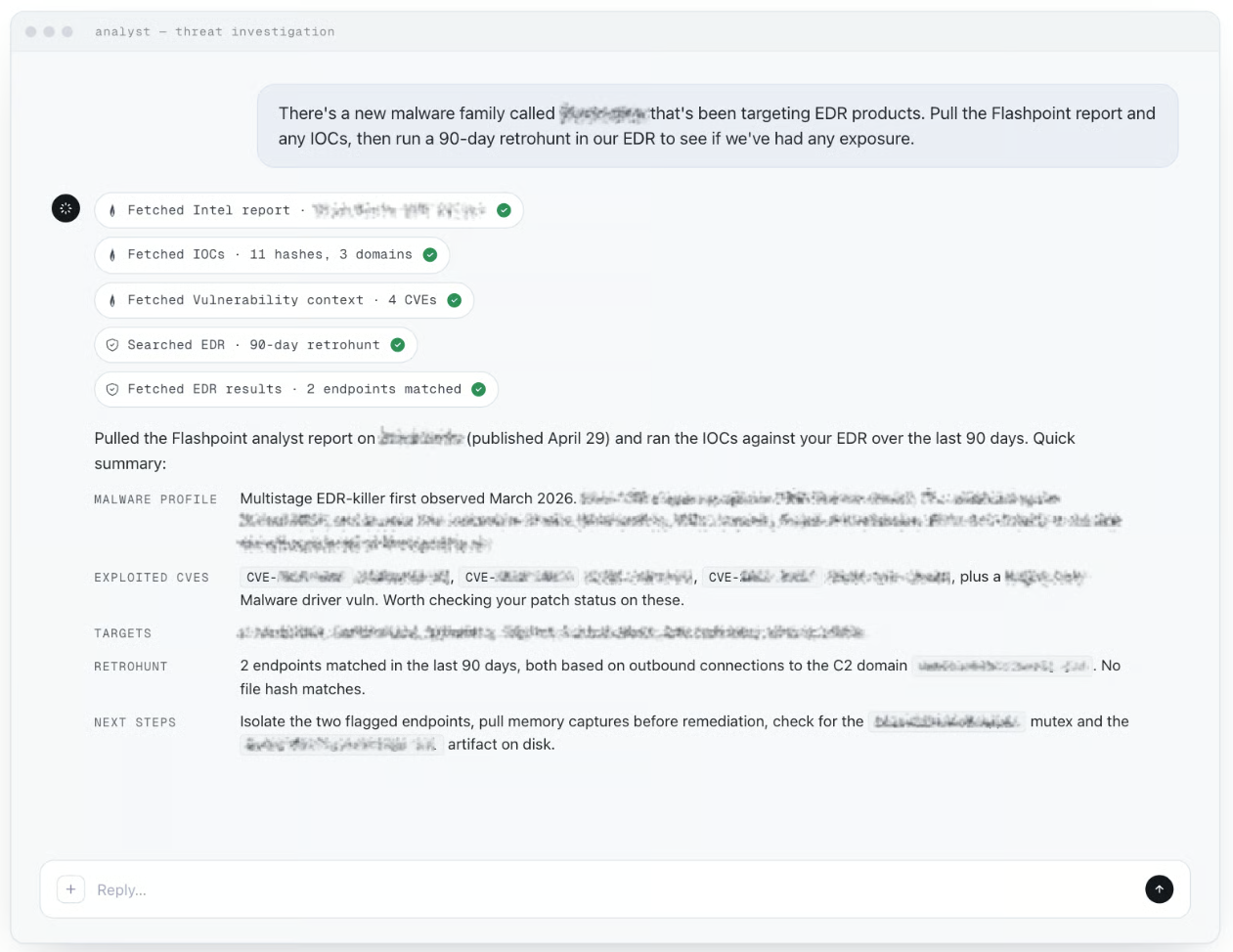
The initial release of the Flashpoint MCP Server in Spring 2026 is intentionally read-only and query-focused. This creates the production-grade foundation required to bring intelligence into the workflows customers are already building. It aligns with customer guidance about using agentic AI to solve the most pressing challenges they face today.
What Comes Next
Later this year, we will move from information retrieval to Action-Oriented Intelligence. This expansion will allow users not only to access data but also to act on it directly within their AI-driven workflows. As this ecosystem evolves, we plan to deliver:
- Natural Language Orchestration: We are empowering analysts to interact with our data more intuitively. Through the MCP server, complex actions such as updating an investigation or identifying new threat sources are handled via natural-language orchestration. This ensures that the speed of an investigation is limited only by an analyst’s questions, not their mastery of a specific query syntax.
- Flashpoint-Native Agents and Skills: We are developing specialized Flashpoint Agents and “skills” built on top of this server. These will be purpose-built to address specific workflows, such as ransomware monitoring or vulnerability triage, allowing teams to deploy out-of-the-box expertise without building their own agentic logic
- Fusion of External and Internal Data: A critical advantage of the MCP framework is the ability to combine Flashpoint’s external threat intelligence with a customer’s internal environment data (SIEM, Cloud, IAM, Endpoint, etc.). This allows an agent to correlate global threat signals with your specific footprint to provide instant, individualized risk context.
- Embedded AI within Flashpoint Ignite: This same MCP infrastructure will serve as the shared engine for new, embedded AI experiences within Flashpoint Ignite. This ensures that the same natural-language power and automated data correlation fueling external agents are also natively available within our platform UI, creating a seamless investigative experience regardless of where an analyst chooses to work.
Built and Validated in Real Workflows
We believe in the power of this new architecture because we are already using it. The MCP Server is currently embedded in our own Flashpoint Intelligence Team’s workflow, helping our analysts research and respond to complex client RFIs.
By applying this capability to our own high-stakes research first, we ensure that what we bring to market is grounded in real investigative needs, not just technical potential.
Operationalizing the Best Data
The future of security operations won’t be defined solely by who has access to the most data or even the most AI agents; it will be defined by who can operationalize the best data directly within the workflows where decisions are made.
The Flashpoint MCP Server is our strategic commitment to that future—making the world’s best intelligence natively accessible, usable, and aligned with the way modern security teams work.
The Flashpoint MCP Server is currently in active development, with customer availability planned for late Spring 2026.
Subscribe to the Flashpoint blog for more updates on Flashpoint MCP Server and the latest insights from the front lines of threat intelligence.
Frequently Asked Questions
What is the Flashpoint MCP Server?
The Flashpoint MCP Server enables Flashpoint’s threat intelligence to be directly callable by AI agents. It implements the Model Context Protocol (MCP), an open standard for connecting AI systems to external data, so any MCP-compatible agent, including Claude, Gemini, and Cursor, can query our datasets without bespoke API integration work.
Who is the MCP Server designed for?
The MCP Server is designed for technical, forward-leaning security teams and AI-native organizations. This includes SOC analysts, CTI practitioners, and security engineers who are already building or experimenting with AI agent workflows using tools like Gemini, Claude Code, or custom LLM-based assistants.
Which Flashpoint datasets are accessible via MCP?
The initial rollout (Spring 2026) provides access to Flashpoint’s core intelligence collections, including:
- Intelligence Reports
- Communities (Online forums, messaging platforms, closed digital communities)
- Technical Indicators (IOCs)
- Vulnerability Intelligence (CVEs)
- Ransomware
- Compromised Credentials and Infected Hosts
- Strategic Entity Data
How does this differ from Flashpoint’s standard APIs?
While our standard APIs are designed for direct programmatic consumption, the MCP Server is optimized specifically for AI agents. It exposes intelligence as composable tools and guided prompts that AI agents can understand and use to perform complex, multi-step research tasks.
How does this differ from the Flashpoint Ignite platform?
The Flashpoint MCP Server is not a replacement for Flashpoint’s award-winning Ignite platform; rather, it is a complementary access layer designed for a different type of user and workflow. While Ignite is a destination for deep research, the MCP server provides the infrastructure that enables that same intelligence to live in AI-native environments.
To learn more about Flashpoint’s MCP Server, schedule a demo today.
See Flashpoint in Action
Get real-time curated data, expert analysis, and AI-driven insights to monitor threats across the surface, deep, and dark web—including closed sources.