IGNITE » EXTERNAL ATTACK SURFACE MANAGEMENT
Flashpoint External Attack Surface Management (EASM)
Flashpoint EASM continuously discovers your unknown internet-facing assets and reveals which ones are exposed to the vulnerabilities attackers are actively exploiting. Stop chasing CVEs that don’t touch your attack surface and start pre-empting the ones that do.
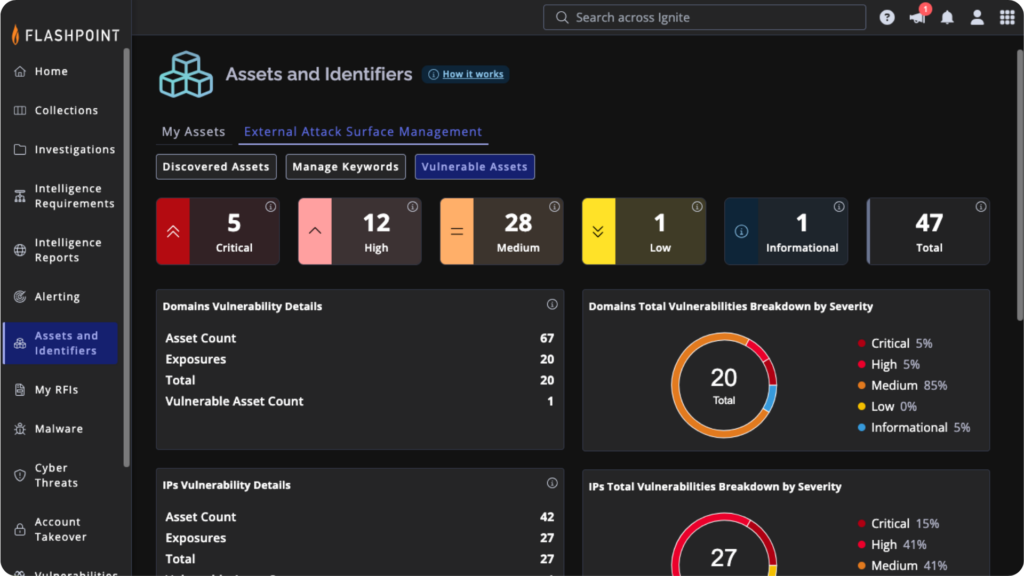
Manage Your External Attack Surface
Up to 95% of an organization’s assets change each year, creating blind spots through shadow IT, forgotten infrastructure, and rapid cloud expansion. Traditional vulnerability scanners look inward at known assets and rely on public data that can lag by weeks, leaving a dangerous gap between disclosure and action. Flashpoint EASM closes this gap by continuously discovering your unknown internet-facing assets and mapping them to Flashpoint’s vulnerability intelligence, including over 105,000 vulnerabilities that public sources miss. The result is a prioritized remediation roadmap built on what attackers are actually exploiting.

External Blind Spots
Organizations cannot secure what they cannot see. Rapid infrastructure changes, cloud migration, and shadow IT create assets that are invisible to security teams but easily found by attackers.

Disconnected Data
Public CVE feeds lag behind real-world exploitation and miss thousands of vulnerabilities entirely. Even when the data is current, teams cannot tie it to specific exposed assets, so remediation stays generic instead of targeted.

Alert Fatigue
Scanners produce thousands of findings, and AI-driven discovery is compounding the volume. Without a way to connect findings to actual exposed assets, teams waste effort on issues that pose no real threat.

Remediation Lag
Vulnerability scanners rely on NVD results, which can take days or weeks to populate. This creates a dangerous window for attackers to weaponize flaws before they appear in public databases.
Turn Intelligence into a
Prioritized Remediation Roadmap
Flashpoint EASM maps every discovered asset to Flashpoint’s industry-leading vulnerability intelligence and surfaces the exposures attackers are most likely to use. Your team gets a prioritized roadmap, faster remediation, and a measurable reduction in cyber risk.
Risk-based prioritization
Eliminate excess noise and focus on the vulnerabilities actively targeted by attackers, not just the ones with high CVSS scores.

Early warning advantage
Detect the riskiest exposures days or weeks before public sources, allowing you to remediate before vulnerabilities are weaponized.
Asset inventory control
Accept or reject discovered assets in a dedicated triage inbox, so your team only spends time on the assets you actually own.
Operational efficiency
Eliminate manual research and fragmented workflows. Move from discovery to remediation faster, all in a single Ignite view.
How Flashpoint EASM Helps

Reveal unknown assets
Forgotten assets and shadow IT remain invisible to security teams, but not to attackers. Flashpoint EASM continuously discovers domains, subdomains, and IP addresses, automatically flagging when a forgotten asset is running software actively targeted by attackers.

Connect vulnerabilities to exposed assets
CVE and NVD tell you what is broken in the world. They don’t tell you what is broken on your perimeter. Flashpoint EASM maps discovered assets directly to Flashpoint’s Vulnerability Intelligence and shows you which software component and version is responsible for each finding.

Prioritize what attackers are exploiting
Vulnerability feeds surface thousands of CVEs, but not which ones attackers are actually using. Flashpoint surfaces findings tagged to actively exploited vulnerabilities, drawing on both the CISA KEV list and Flashpoint’s proprietary list, so your team focuses on what’s being used in real attacks.
Remediate Faster
Patching cycles slow down while your team waits for public databases to catch up. Flashpoint bypasses this lag with pre-NVD findings and non-published vulnerabilities, giving your team the context to accelerate patching across the external attack surface.
Frequently Asked Questions
-
Flashpoint EASM continuously discovers your internet-facing assets (domains, subdomains, and IP addresses), then identifies which ones are exposed to known and actively exploited vulnerabilities. A setup wizard handles the initial configuration with your ‘seed’ assets, and discovery expands from there as your perimeter changes.
-
EASM is an add-on module inside Ignite. Discovered assets and alerts appear in the same workflow as your CTI and Vulnerability Intelligence. There is no separate console to learn or maintain.
-
Scanners and EASM are complementary. Scanners rank findings mainly by CVSS severity. Flashpoint EASM ranks findings by what attackers are actively exploiting, drawing on pre-NVD intelligence and the 105,000-plus vulnerabilities public sources miss. It also discovers unknown assets, such as shadow IT, that scanners alone do not detect.
Product News
-

Aug 6: Search and Discover Using Natural Language in Echosec
Flashpoint’s geospatial open-source intelligence tool, Echosec, now features Natural Language Search and AI Results Refinement, bringing an intuitive approach to search and discovery in the Locate view.
-
 Product Updates
June 25: Introducing the Flashpoint MCP Server
Announcing a major transformation for Flashpoint Managed Attribution: a full product redesign and the introduction of the powerful, built-in Anonymous Browser capability.
-
Product Updates
May 28: Intelligence Requirements in Flashpoint Ignite
Announcing a major transformation for Flashpoint Managed Attribution: a full product redesign and the introduction of the powerful, built-in Anonymous Browser capability.
