How to Evaluate a Threat Intelligence Platform in 2027
A threat intelligence platform should help your team find the threats that affect your organization, verify them quickly, and act on them inside the tools you already use. This guide covers seven criteria for evaluating platforms in 2027, the questions to ask in a demo, and the mistakes to avoid.
 Flashpoint


Threat intelligence teams are being asked to monitor more threats, support more use cases, and deliver faster answers, often without additional resources. According to Flashpoint’s Enterprise Threat Intelligence Report: 2026, 65% of respondents identified alert noise and false positives as a top-three challenge affecting their programs. Another 55% cited insufficient analyst bandwidth, while 50% pointed to tool integration and interoperability challenges.
Meanwhile, the threat landscape continues to expand. Flashpoint’s Global Threat Intelligence Report: 2026 Midyear Edition found that infostealers harvested more than 1.7 billion credentials from 7.4 million infected devices in the first half of 2026. More than 21,000 vulnerabilities were disclosed during the same period, 19% of which already had public or functional exploit code. Threat actors also posted more than 22 million times about AI toolkits intended for criminal use.
For organizations evaluating threat intelligence platforms in 2027, the challenge is finding a solution that can turn this growing volume of information into relevant intelligence that security teams can investigate and act on.
This guide covers seven criteria to consider when comparing threat intelligence platforms, questions to ask prospective vendors, and how to evaluate their capabilities against your organization’s security priorities.
What Is a Threat Intelligence Platform?
A threat intelligence platform (TIP) is technology that helps organizations collect, analyze, and act on information about current and emerging threats. Security teams use these platforms to support threat detection, incident response, vulnerability management, fraud prevention, and executive protection.
Threat intelligence solutions generally fall into two broad models. Traditional TIPs aggregate indicators of compromise (IOCs) from multiple third-party feeds and distribute them to security tools. More comprehensive threat intelligence platforms collect intelligence directly from the sources where threats originate, combining that data with finished analysis, investigation tools, alerting, and integrations.
The distinction matters because indicators alone rarely explain whether a threat affects a particular organization. A feed containing millions of IOCs may offer less immediate value than a verified alert identifying an employee’s compromised credentials, the source of the exposure, and the information needed to investigate.
Flashpoint Ignite is an example of a comprehensive threat intelligence platform, combining Flashpoint Primary Source Collection, finished intelligence, investigation capabilities, and integrations across cyber threat intelligence, vulnerability intelligence, fraud, physical security, and brand protection.
Seven Key Criteria for Evaluating a Threat Intelligence Platform in 2027
1. Intelligence Coverage and Source Access
Start by examining where a provider collects intelligence and how much visibility it maintains into the environments where threats originate.
Threat actors operate across illicit forums, marketplaces, encrypted messaging channels, ransomware leak sites, and infostealer log shops. Intelligence collected from these sources can expose compromised credentials, planned attacks, emerging exploits, and other threats before they appear in an organization’s internal security telemetry.
However, vendors that advertise coverage of the same source categories may differ considerably in the depth, continuity, and historical reach of their collection.
Questions to ask when evaluating intelligence coverage:
- Source diversity: Does the provider collect intelligence from the open, deep, and dark web, including restricted forums, illicit marketplaces, and messaging platforms?
- Historical visibility: How far back can analysts search to investigate recurring activity, relationships between threat actors, and changes in behavior?
- Collection continuity: How does the provider maintain visibility when communities migrate, restrict access, or shut down?
- Organizational relevance: Does the intelligence cover the threat actors, industries, geographic regions, and assets that matter to your organization?
How Flashpoint addresses it
Flashpoint Primary Source Collection gathers intelligence directly from the digital environments where threats originate, including open and hard-to-reach sources. Its collection supports investigations across illicit communities, marketplaces, messaging platforms, and other environments where adversaries exchange information.
In The Forrester Wave™: External Threat Intelligence Service Providers, Q3 2026, where Flashpoint was named a customer favorite, Forrester described Flashpoint as ideal for customers seeking primary-source access intelligence, particularly in the financial industry.
Flashpoint Ignite also supports priority intelligence requirements (PIRs), helping teams align their intelligence collection and monitoring with the risks most relevant to their organizations.
2. Intelligence Quality and Analytical Expertise
Access to threat data is only valuable when analysts can determine which findings are credible, relevant, and worth investigating.
In Flashpoint’s Enterprise Threat Intelligence Report, 65% of respondents cited alert noise and false positives among their top three operational challenges. Intelligence quality therefore has a direct impact on analyst capacity. Outdated, duplicated, or poorly contextualized findings can create additional investigations without improving an organization’s understanding of risk.
Look at how each provider validates collected information, enriches indicators, connects related datasets, and communicates confidence in its assessments.
Questions to ask when evaluating intelligence quality:
- Validation: How does the provider verify findings and assess source credibility?
- Analytical context: Does the platform provide finished intelligence alongside raw data and technical indicators?
- Evidence transparency: Can analysts access the underlying sources supporting an alert or assessment?
- Expert support: Can customers submit requests for information (RFIs) or consult the provider’s intelligence analysts?
- Confidence assessments: How does the provider distinguish confirmed activity from preliminary reporting or lower-confidence findings?
How Flashpoint addresses it
Flashpoint combines primary-source intelligence with analysis from a multilingual team of intelligence professionals. Within Ignite, analysts can investigate underlying evidence, review finished intelligence, and submit RFIs when they need additional context or deeper research.
This combination of collection and analyst expertise is particularly valuable when investigations require understanding adversary behavior, underground communities, or emerging threats that have not yet been widely documented.
As one Flashpoint customer, a senior cybersecurity engineer in the healthcare and biotech industry, explained:
3. Actionability and Integration With Security Workflows
Threat intelligence needs to reach the systems and people responsible for taking action. Even highly relevant findings can lose value when analysts must manually transfer information between disconnected tools.
In Flashpoint’s Enterprise Threat Intelligence Report, 50% of respondents identified tool integration and interoperability as a top-three challenge affecting their threat intelligence programs.
The report also describes how manual handoffs between intelligence feeds, SIEMs, SOAR platforms, ticketing systems, and response workflows consume analyst time. These gaps can delay investigations and make it harder to consistently apply intelligence across security operations.
When evaluating a platform, examine how intelligence moves from discovery through validation, prioritization, and response.
Questions to ask when evaluating integrations:
- Existing technology: Does the platform integrate with your SIEM, SOAR, EDR, vulnerability management, and ticketing systems?
- Integration methods: Does it support APIs, prebuilt connectors, machine-readable feeds, and standards such as STIX and TAXII?
- Workflow enrichment: Can intelligence add context to existing alerts, investigations, and incident response processes?
- Asset-specific alerting: Can teams configure alerts around their organization’s domains, brands, executives, and technologies?
- Operational efficiency: Can the platform reduce duplicate findings, unnecessary manual steps, and irrelevant alerts?
During a demonstration, ask the vendor to show a realistic workflow. For example, what happens when an employee’s credentials appear in a newly collected infostealer log? Can the platform identify the exposure, provide supporting context, and deliver the information to the team responsible for remediation?
How Flashpoint addresses it
Flashpoint Ignite supports intelligence sharing through APIs, STIX/TAXII, MISP, and integrations with established security and investigation platforms.
These include SIEM and SOAR tools such as Splunk, QRadar, Elastic, and Cortex XSOAR; threat intelligence platforms such as Anomali ThreatStream and ThreatConnect; and ServiceNow security workflows.
Ignite also supports alerts based on organizational assets and intelligence requirements, helping teams route relevant findings into existing operational processes.
A Flashpoint customer in the financial sector described how these capabilities support its security program:
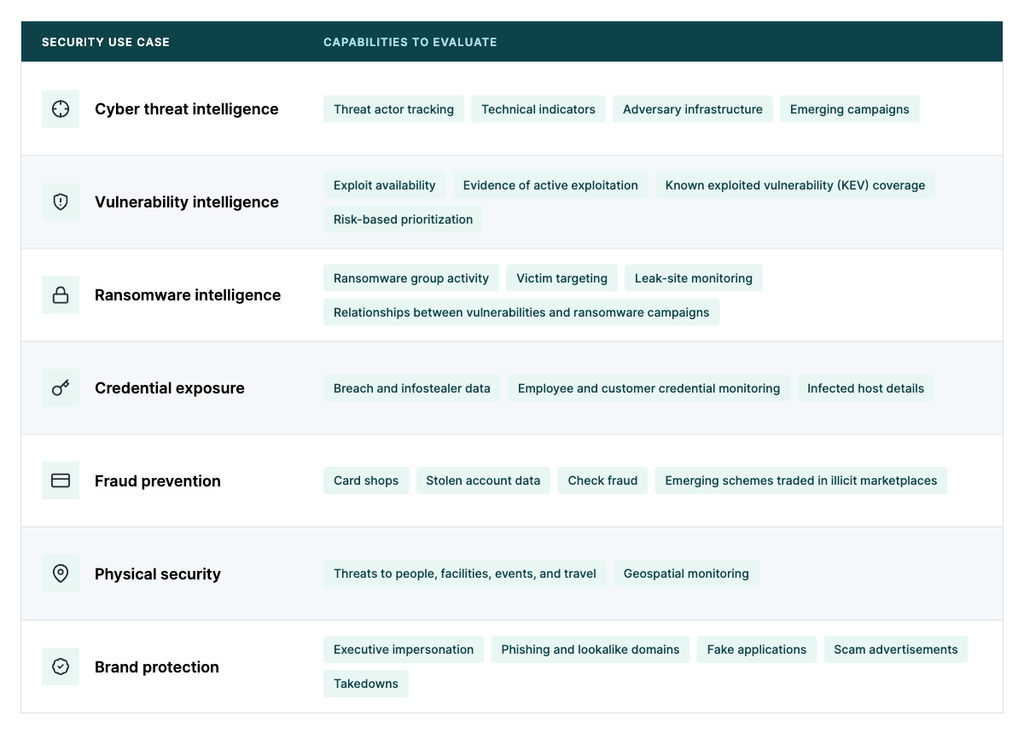
4. Threat Intelligence Capabilities by Use Case
The right threat intelligence platform depends on the risks an organization needs to monitor.
A financial institution managing account takeover and payment fraud may prioritize compromised credentials and illicit marketplaces. A critical infrastructure operator may need deeper visibility into vulnerability exploitation, ransomware groups, and physical security threats.
Begin with your organization’s priority use cases, then assess how well each vendor supports them.
Questions to ask when evaluating use-case coverage:
- Priority alignment: Which of our highest-priority intelligence requirements can the platform address?
- Depth of coverage: How much relevant intelligence and investigative context is available for each use case?
- Cross-functional visibility: Can different teams use the same intelligence foundation to investigate related threats?
- Specialized capabilities: Does the platform provide the monitoring, analysis, and response support needed for our particular risks?
- Expansion: Can we add new use cases as our security requirements evolve?
How Flashpoint addresses it
Flashpoint Ignite supports intelligence workflows spanning cyber threat intelligence, vulnerability intelligence, compromised credentials, ransomware, fraud, physical security, and brand protection.
For vulnerability management teams, Flashpoint provides exploitability intelligence, evidence of active exploitation, and risk-based signals to help prioritize remediation. Its known exploited vulnerability catalog also tracks exploitation activity beyond vulnerabilities included in CISA’s KEV catalog.
For fraud teams, Flashpoint provides visibility into illicit marketplaces, compromised accounts, and emerging schemes. Physical security and executive protection teams can use intelligence from online environments to investigate potential threats to people, facilities, and events.
Flashpoint received the highest possible scores in the Fraud Intelligence and Executive Protection criteria in The Forrester Wave™: External Threat Intelligence Service Providers, Q3 2026.
5. AI and Agentic Capabilities
AI is becoming an increasingly important consideration in threat intelligence platform evaluations.
Flashpoint’s Enterprise Threat Intelligence Report found that 45% of respondents were already using or piloting agentic AI in their threat intelligence workflows, while another 35% planned to adopt it within the next 12 to 24 months.
Organizations are exploring AI to reduce repetitive work, accelerate investigations, and help analysts manage expanding intelligence requirements. At the same time, the research found that teams are setting high expectations for accuracy, transparency, and control.
Some threat intelligence platforms use machine learning for classification and pattern detection. Others incorporate generative AI for natural-language search, summarization, and reporting. Agentic capabilities extend further, supporting multi-step workflows such as investigations, alert triage, and intelligence briefings.
The distinction matters when evaluating how much work a platform can perform and what oversight those activities require.
Questions to ask when evaluating AI capabilities:
- Practical applications: Which intelligence workflows can AI accelerate, and what measurable improvements does it deliver?
- Source verification: Can analysts trace AI-generated findings to the intelligence and evidence supporting them?
- Accuracy and reliability: How does the provider evaluate AI output and reduce inaccurate or unsupported findings?
- Human oversight: Which actions require analyst review or approval, and what controls govern agent permissions?
- Security and governance: How does the platform address sensitive data access, auditability, and regulatory requirements?
- Operational impact: Does AI reduce repetitive investigations and alert noise, or introduce additional review work?
One participant in Flashpoint’s Enterprise Threat Intelligence Report summarized the concern:
“An agent that’s confidently wrong is worse than one that’s slow.”
The level of autonomy should reflect the consequences of the task. Summarizing intelligence or drafting a briefing may require different controls than modifying detection rules or initiating a security response.
How Flashpoint addresses it
Flashpoint AI supports intelligence analysis through capabilities such as natural-language queries, source-linked summaries, reporting assistance, and search across collected intelligence. The Flashpoint MCP Server also connects Flashpoint intelligence with compatible AI assistants and workflows.
Flashpoint Agentic AI extends these capabilities through purpose-built agents designed to support intelligence workflows. Its offerings include Agentic Hub within Ignite and agentic capabilities across Flashpoint products, including the Echosec Reporting Agent.
The approach emphasizes primary-source intelligence, verifiable findings, and analyst oversight, helping teams apply AI to intelligence work while retaining control over consequential decisions.
6. Scalability, Usability, and Analyst Efficiency
A platform’s value also depends on how easily analysts can use it and whether it can support the program as requirements grow.
In Flashpoint’s Enterprise Threat Intelligence Report, 55% of respondents cited insufficient analyst bandwidth as a top-three challenge. One healthcare threat intelligence leader explained:
“Good analysts take time to develop and train, and we can’t hire our way out of that problem.”
Smaller teams may prioritize intuitive workflows and automated prioritization. Larger organizations may need granular access controls, advanced investigations, shared workspaces, and support for multiple security functions.
In either case, the goal is to reduce the time spent collecting, sorting, and transferring information so analysts can focus on investigations requiring their expertise.
Questions to ask when evaluating usability and scalability:
- Investigation experience: Can analysts search across sources, pivot between related findings, and investigate without switching between multiple interfaces?
- Collaboration: Can teams share findings, notes, and investigations across departments or business units?
- Onboarding and training: What resources are available to help analysts become productive?
- Program growth: Can the platform support additional users, use cases, and intelligence requirements?
- Provider support: What assistance is available when teams encounter unfamiliar threats or need to adjust their intelligence programs?
How Flashpoint addresses it
Flashpoint Ignite brings multiple intelligence capabilities into a common environment, allowing teams to search, investigate, and collaborate across different threat categories.
Analysts can use search filters, natural-language capabilities, shared investigations, and reporting tools to work with collected intelligence. Flashpoint also provides onboarding, training, and access to intelligence specialists to support customers as their requirements evolve.
In The Forrester Wave™: External Threat Intelligence Service Providers, Q3 2026, Flashpoint was named both a Customer Favorite, reflecting feedback from reference customers. Forrester specifically noted customers’ appreciation of Flashpoint’s white-glove approach to addressing their needs.
That level of support matters when a threat intelligence program must expand into new use cases or respond to unfamiliar risks.
7. Measurable Value and Total Cost of Ownership
Platform licensing is only one component of the investment. Organizations should also account for implementation, integrations, analyst training, ongoing administration, and any additional services required to operationalize the intelligence.
Flashpoint’s Enterprise Threat Intelligence Report found that 50% of respondents expected their threat intelligence budgets to increase over the next 12 months, while another 40% expected budgets to remain essentially flat. None anticipated a decrease.
With investment continuing, security leaders need a clear way to demonstrate whether their platforms improve operational performance and reduce risk.
Useful metrics include time to identify and investigate relevant threats, hours of manual collection and enrichment saved, speed of vulnerability prioritization and remediation, number of exposures identified and addressed, and time from discovery to response.
Questions to ask when evaluating total cost and ROI:
- Licensing transparency: Which capabilities, integrations, services, and usage levels are included in the quoted price?
- Implementation requirements: What internal resources are needed for deployment, administration, and ongoing maintenance?
- Operational savings: How can the platform reduce manual investigation work or consolidate overlapping tools?
- Security outcomes: Which measurable improvements can the provider demonstrate for our priority use cases?
- Long-term flexibility: Can licensing and capabilities expand as requirements change without requiring a complete platform replacement?
How Flashpoint addresses it
Flashpoint Ignite combines a core intelligence foundation with additional capabilities based on organizational requirements. This approach gives customers flexibility to align their investment with the intelligence use cases they need.
Flashpoint received the highest possible score for Pricing Flexibility and Transparency in The Forrester Wave™: External Threat Intelligence Service Providers, Q3 2026.
Customer outcomes can also provide evidence of operational value. For example, an SVP of Cyber Operations at a large U.S. financial institution reported:
When comparing vendors, look for evidence tied to outcomes relevant to your organization rather than relying exclusively on feature counts or projected efficiency gains.
Five Questions to Ask During a Threat Intelligence Platform Demo
A product demonstration is an opportunity to test vendor claims against your organization’s actual security requirements.
Before the demo, identify two or three realistic scenarios, such as a compromised executive credential, a newly exploited vulnerability affecting your technology stack, or ransomware activity targeting your industry.
Ask each vendor to demonstrate how its platform handles those scenarios, including the intelligence available, the investigative steps required, and the actions your team can take.
Five questions that can help structure the evaluation:
- Can you demonstrate a relevant investigation? Ask the vendor to work through a threat scenario that reflects your organization’s industry, assets, or intelligence requirements.
- How does the platform prioritize threats specific to us? Look for asset-based monitoring, contextual enrichment, and evidence that helps distinguish relevant threats from general activity.
- How much work does the platform require? Evaluate the time and resources needed for implementation, administration, investigation, and integration with existing systems.
- How do customers measure success? Ask for examples of improvements in analyst efficiency, response time, risk reduction, or financial outcomes.
- What is included in the proposed solution? Clarify which intelligence capabilities, integrations, analyst services, and AI features require additional licensing.
Where available, consider a hands-on evaluation using representative requirements and agreed success criteria. This can help establish how the platform performs beyond a scripted demonstration.
Common Mistakes to Avoid When Comparing Threat Intelligence Platforms
Prioritizing data volume over relevance. Large numbers of indicators or collected records do not necessarily translate into better threat visibility. Evaluate the quality, timeliness, context, and relevance of the intelligence.
Treating all sources as equivalent. Vendors may advertise similar collection categories while offering different levels of access, historical coverage, and original source material. Ask for examples that demonstrate actual collection depth.
Comparing features without testing workflows. A checklist can establish whether a capability exists, but it does not show how efficiently an analyst can complete an investigation or operationalize a finding.
Overlooking analyst expertise and support. Complex investigations often require specialized knowledge of adversary behavior and underground ecosystems. Evaluate the expertise and assistance available beyond the platform itself.
Assuming AI guarantees better intelligence. Assess AI-generated findings for accuracy, transparency, and practical value. Understand which actions are automated, which require approval, and how analysts can verify the underlying evidence.
Frequently Asked Questions
What is the difference between a threat intelligence platform and a threat intelligence feed?
A threat intelligence feed delivers data such as malicious IP addresses, domains, and file hashes. A threat intelligence platform provides additional capabilities for collecting, analyzing, investigating, contextualizing, and distributing intelligence so teams can make informed security decisions.
What should I look for in a threat intelligence platform?
Evaluate intelligence coverage, source quality, analytical expertise, security integrations, support for your priority use cases, AI capabilities, usability, and total cost of ownership. A demonstration using your organization’s actual requirements can help establish which platform is the best fit.
Is Flashpoint a threat intelligence platform?
Yes. Flashpoint Ignite combines primary-source collection, finished intelligence, investigation tools, alerting, and integrations. It supports use cases including cyber threat intelligence, vulnerability intelligence, fraud, compromised credentials, physical security, and brand protection.
How is AI changing threat intelligence platforms in 2027?
AI is expanding from search and summarization into more complex intelligence workflows, including investigations, briefings, and alert triage. Organizations evaluating these capabilities should consider accuracy, source transparency, access permissions, auditability, and the level of human oversight required.
Should I run a proof of concept before selecting a threat intelligence platform?
A proof of concept or structured hands-on evaluation can help validate a platform against real intelligence requirements. Where a formal proof of concept is unavailable, a scenario-based demonstration with agreed evaluation criteria can still provide useful evidence.
Choosing the Right Threat Intelligence Platform for 2027
The right threat intelligence platform should reflect your organization’s risk profile, intelligence requirements, and operational capacity.
Start by identifying the threats your team needs to understand and the workflows the platform must support. Then compare providers on their intelligence coverage, analytical depth, integrations, and ability to demonstrate measurable results.
As intelligence requirements expand and AI becomes more deeply embedded in security operations, source transparency and analyst control will remain important considerations.
Flashpoint Ignite brings primary-source intelligence, investigation capabilities, and expert analysis together to support security teams across a broad range of use cases.
See how Flashpoint Ignite supports your organization’s intelligence requirements. Request a demo.
See Flashpoint in Action
Get real-time curated data, expert analysis, and AI-driven insights to monitor threats across the surface, deep, and dark web—including closed sources.